封神榜
Study: ‘6G’ Radiation Boosts Brain Cell Growth in Mice_我的网站

一 |
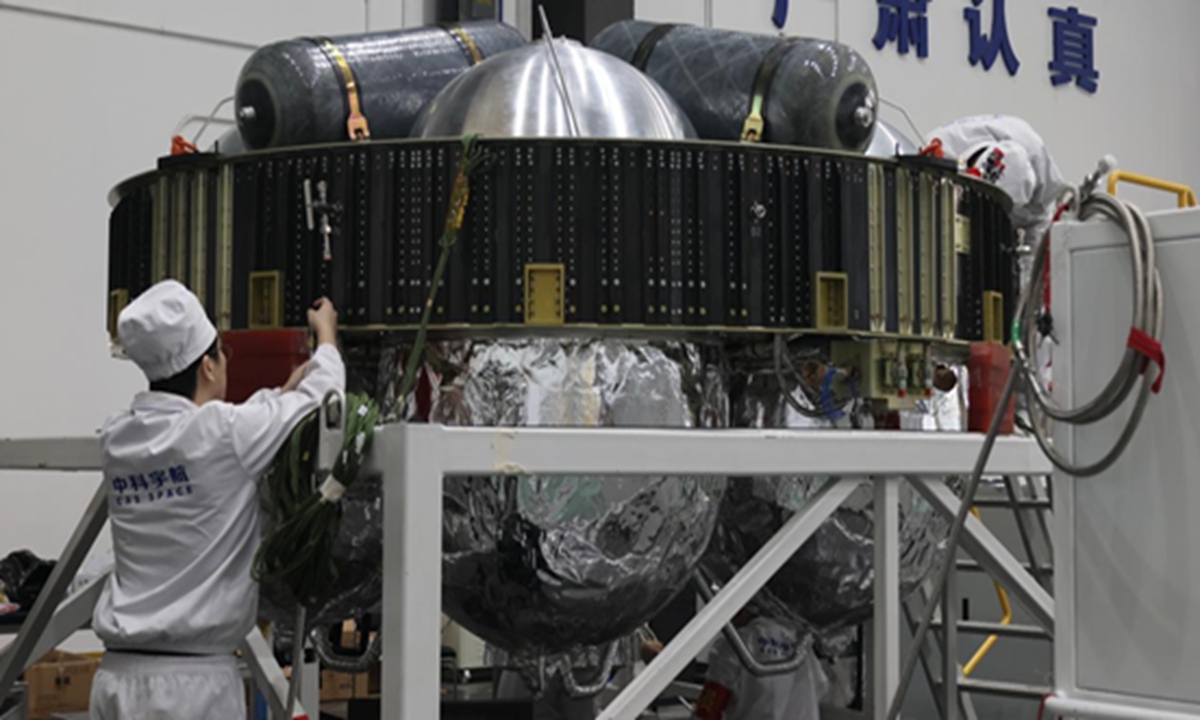
The general assembly of the Lixun-1 upper stage Photo: Courtesy of CAS Space
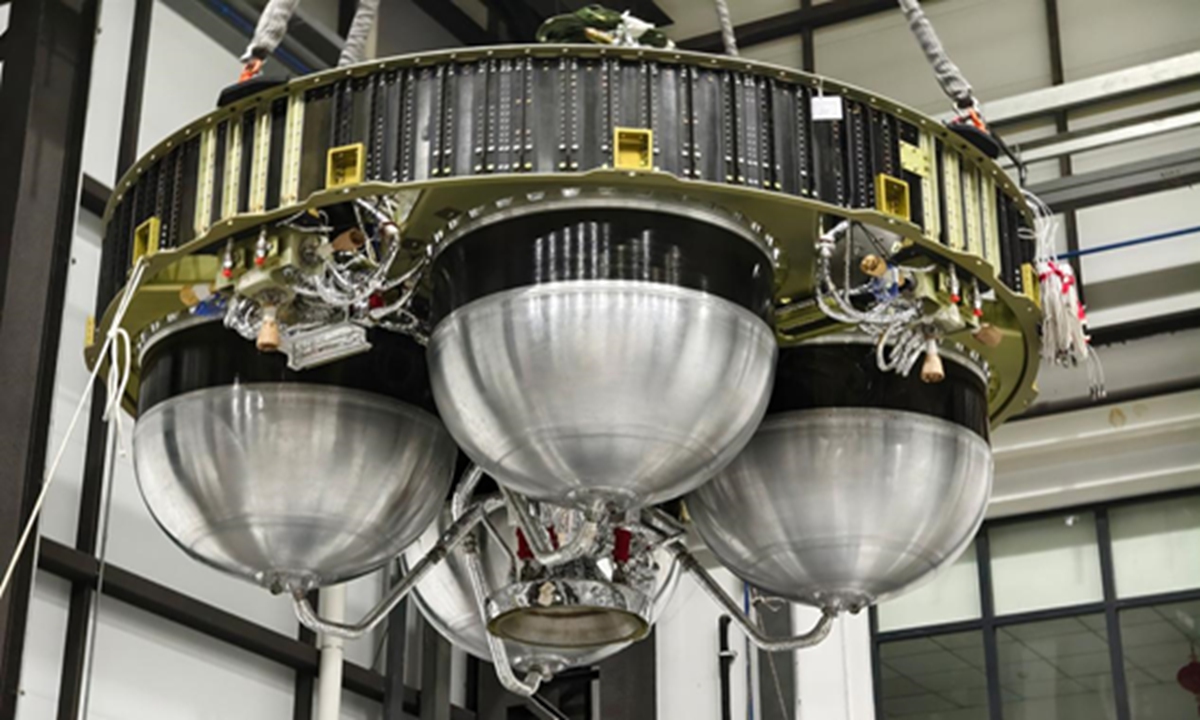
The Lixun-1 upper stage Photo: Courtesy of CAS Space
Lixun-1 upper stage, a versatile "space tug" developed by China's commercial space firm CAS Space, is scheduled to make its maiden flight in the first quarter of 2027 after completing a series of key propulsion-system tests, the developer and its chief designer told the Global Times on Tuesday.
The "tug" is designed to ferry satellites from one orbit to another and support missions ranging from constellation deployment to lunar exploration.
While the main stages of a rocket carry payloads from the ground into an initial orbit, an upper stage takes over once the craft is in space. By repeatedly restarting its engine and changing orbit, Lixun-1 can deliver satellites to higher or different orbits, distribute multiple spacecraft to separate destinations during a single launch, or send probes onto trajectories toward the moon and beyond, Global Times learned from the developer.
Yang Haoliang, chief designer of the Lixun-1 upper stage, compared the system to a shuttle service. "If the regular stages of a launch vehicle are like a long-distance bus," - they carry the upper stage and satellites from Earth to a near-Earth parking orbit - the upper stage then takes over as a "space tug," carrying its satellite "passengers" onward to their designated orbital "stops," Yang explained.
That capability can have a direct impact on how efficiently satellites are launched and operated, Yang said. If a satellite has to climb from an initial orbit to its final destination using its own engine, the process can consume a considerable amount of onboard propellant and reduce the fuel available during its operational life. An upper stage can instead perform that orbital transfer, helping conserve satellite fuel and potentially extend its service life.
It can also make one rocket launch do more work. Instead of releasing a batch of satellites into roughly the same orbit, Lixun-1 can repeatedly ignite its engine and maneuver between deployments, sending different satellites to different altitudes and inclinations. Yang said this would help accelerate constellation deployment while improving the efficiency of individual launches.
The practical ambitions behind the system are backed by a major technical milestone reached this month. In August, Lixun-1 completed its PV-001 integrated propulsion-system coordination firing test, during which the entire system operated smoothly for 566 seconds.
Yang told the Global Times that the current Lixun-1 upper stage has a thrust of 20 kilonewtons and can achieve a specific impulse of 315 seconds, which he described as reaching an internationally leading level. The August firing covered the planned profile for the maiden mission, an important step before the system proceeds to flight testing.
The test was more than a demonstration of the engine itself. As an important system-level verification during development, it examined the coordination and engineering reliability of the engine pressurization system, propellant delivery system, propellant management system and servo-control system under the fully integrated configuration.
Of a series of tests that accumulated 5,211 seconds of firing time, the latest one focused on three core technologies: a high-thrust, high-performance 20-kilonewton upper-stage engine capable of multiple starts; balanced propellant delivery from multiple parallel tanks; and a highly reliable integrated electrical system. Their successful verification means Lixun-1 has completed its system-level testing and is ready to move into the flight-test phase, according to the developer.
Lixun-1 has been designed as a modular and generally adaptable upper stage rather than a system tied to only one rocket. It is intended to work with CAS Space's Kinetica-2 and Kinetica-2 heavy-lift variants as well as other launch vehicles, Yang said.
When paired with the Kinetica-2 family, Lixun-1 could significantly expand the rocket's mission range. For communications missions, it could deliver satellites to geosynchronous transfer orbit or even directly to geosynchronous orbit, conserving satellite propellant while supporting the deployment of high-throughput satellites and future 6G communications spacecraft.
For multi-satellite missions, the combination could distribute spacecraft to different orbital altitudes and inclinations during a single launch, potentially serving both low-Earth-orbit constellations and medium- or high-orbit payloads. For deep-space missions, it could place probes onto Earth-moon transfer trajectories and support lunar exploration, Yang said.
The upper stage is designed to be able to conduct more than 20 engine ignitions, autonomously plan orbital-transfer routes and operate under the vacuum and extreme temperature conditions of space. After completing payload deployment, it can also carry out orbital disposal maneuvers to reduce space-debris risks.
Yang said the Lixun-1 and Kinetica-2 combination is designed to cover the vast majority of commercial satellite launch requirements while retaining the ability to participate in major national space projects. More broadly, the upper stage forms part of CAS Space's effort to build launch capabilities reaching medium and high Earth orbits and deep space, extending the reach of China's commercial space sector toward higher orbits and more distant destinations.
。 The same technology that may power the next generation of mobile networks has been shown to increase the growth of brain cells in mice, according to a new study from Xian Jiaotong University in Beijing.,Radio waves in the terahertz frequency can transmit data at speeds up to 1 terabit (or 125 gigabytes) per second, it is a prime candidate for the next generation of mobile cell phone networks if it can be proven safe. By contrast, current 5G networks use millimeter waves that top out at 20 gigabits (2.5 gigabytes) per second.,But there may be another use for terahertz radio waves: treatment of neurological disorders like Alzheimer’s disease, autism, and Parkinson’s disease.,Science & Tech'Vicious Cycle' Between Alzheimer's Dementia and Daytime Napping Found by Scientists17 March, 19:05 GMT,The researchers exposed mice neurons in a petri dish to 100-microwatt pulse radiation, ranging from 0.3 terahertz to 3 terahertz. The result was that the exposed neurons grew at a rate of 150% compared to the control group. The length of connections also doubled in three days. Despite the accelerated growth, the brain cells appeared healthy.,The accelerated brain growth was not permanent; it slowed two days after exposure.,However, a 2009 study by the Russian Academy of Sciences showed that prolonged exposure to strong terahertz radiation had an adverse effect, increasing the temperature of brain cells, disturbing their development and causing dehydration of the cells which reduces their size and causes other damage.,But Li Xiaoli, the lead scientist of the new Beijing study, thinks that the negative effects of terahertz radiation could be avoided by limiting the strength and duration of exposure.,“The safety of terahertz radiation protocol is a top concern,” Li said. And while the health concerns of terahertz radiation remain, it could, Li believes, be used to treat neurological disorders.,“Abnormal neuron development and the resulting abnormal neural network structure can lead to the occurrence of various psychiatric and neurological diseases, such as Alzheimer’s disease, autism and Parkinson’s disease,” the study’s authors said.,The authors believe that a lower dose of terahertz radiation could increase the production and the activity of certain proteins responsible for brain cell growth, namely GluA1, GluN1, and SY-38. The researchers theorize that is because they contain hydrogen bonds that constantly vibrate at a frequency that falls in the terahertz range. The radio waves combine with the proteins and cause them to resonate in a “non-linear manner,” according to Li, which could “affect the shape of the proteins, and therefore the structure and function of neurons.”However, because proteins vary significantly from each other, only certain proteins are affected by the terahertz radiation at low frequencies. Li says more investigation is needed to learn how proteins react to different exposure intensities.,The study backs up another done at the Institute of Brain Science at Xian Jiaotong University that was published in June. That study found that terahertz exposure could make young mice more intelligent. There, scientists exposed mice to 90-milliwatt terahertz radiation for 20 minutes a day for three weeks. They observed that the exposed mice had more brain cells and were quicker at escaping mazes. However, for reasons that remain unclear, the same effect was not observed in older mice.。
Current article:http://85l43l.mexuanmeixuyaopinzheng.shop/neu/4zrre.html
Published on:03:26:09
